

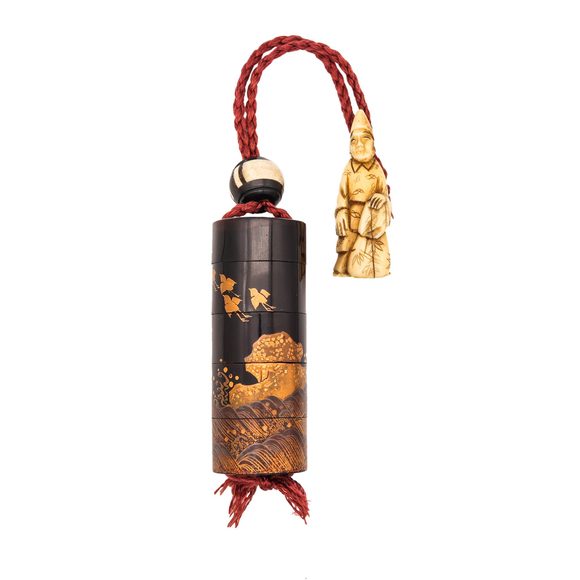


Japanese Inro from the Meiji Period (1868-1912).Beautiful Inro, created in Japan during the Meiji imperial period, circa 1870. It was carefully crafted in carved precious wood with applications of lacquer and decorated with orientalism patterns. All dan trays are attached together with a himo cord. The detailed craftsmanship was a true pleasure to behold.Period: Meiji 1868-1912, Period of Emperor Mutsuhito.Approximate Date: 1870.Motif: Organic design with cascade landscape scene and five flying cranes.Drawers: Five.Shape: Cylinder. Very unusual and rare shape.Technique: Carved wood, Lacquer, hiramaki-e, takamaki-e, Gilding.Ojime: 17mm, round with Ebony wood.Netsuke: Carved dressed standing monk with a hat and holding a bag.Weight: 46.60 Grams.Measurements: Inro diameter of 30 mm, height of 78 mm (1.18 x 3.07 Inches)..Meiji PeriodThis was an era of Japanese history that extended from October 23, 1868 to July 30, 1912.The Meiji era was the first half of the Empire of Japan, when the Japanese people moved from being an isolated feudal society at risk of colonization by Western powers to the new paradigm of a modern, industrialized nation state and emergent great power, influenced by Western scientific, technological, philosophical, political, legal, and aesthetic ideas. As a result of such wholesale adoption of radically different ideas, the changes to Japan were profound, and affected its social structure, internal politics,


